Business Mentor: Does It Actually Change Anything, or Just Sound Good?
The most common question I hear from founders before we start working together is: how do I know this will actually change anything? Here's an honest answer, based on data and what I actually see with my clients.

Business Mentor: Does It Actually Change Anything, or Just Sound Good?
The most common question I hear from founders before we start working together is: how do I know this will actually change anything? Here's an honest answer, based on data and what I actually see with my clients.
Who it's for: founders and managers wondering if business mentoring or strategic consulting offers real value or is just another budget expense.
Why you should read it: you'll find data on how mentoring affects a company's survival and growth, one of the most important concepts in management science—the "knowing-doing gap"—and five real-life situations from my clients that show exactly where a mentor makes a difference.
Reading time: approx. 8 minutes.
I'll start with the question I hear most often
"I don't know if this will actually change anything." I hear this sentence, or variations of it, from potential clients more than anything else. And I think it's a very good question. Too many people sell mentoring and consulting based on emotions, promises of transformation, and case studies with no substance. You deserve an honest, data-driven answer, so I'll start there.
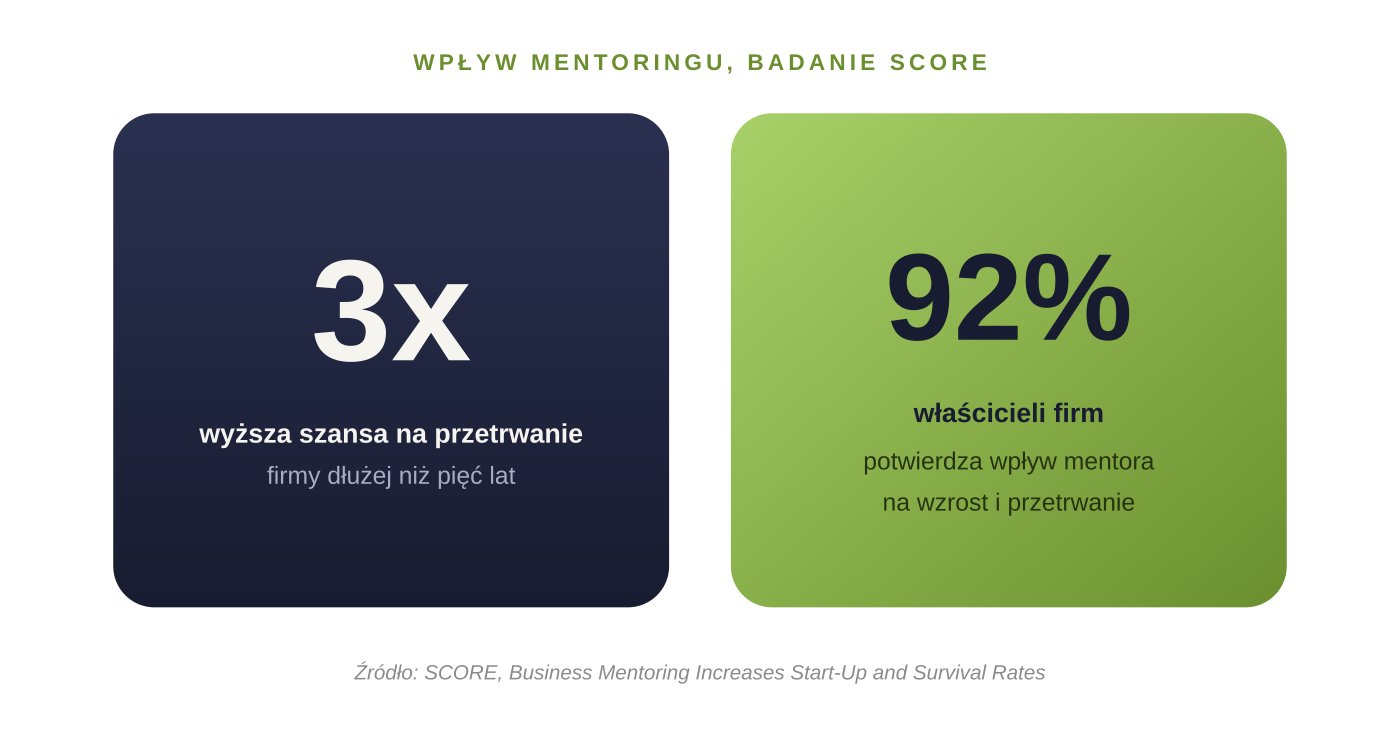
A study by SCORE, the largest network of volunteer business mentors in the US, showed that startups working with a mentor are three times more likely to survive in the market for more than five years [1]. 92% of small business owners agree that mentors have a direct impact on the growth and survival of their business [1]. Founders working with coaches grow their revenue 46% faster, and companies that use consultants for strategic planning report an average return on investment of 500% [2].
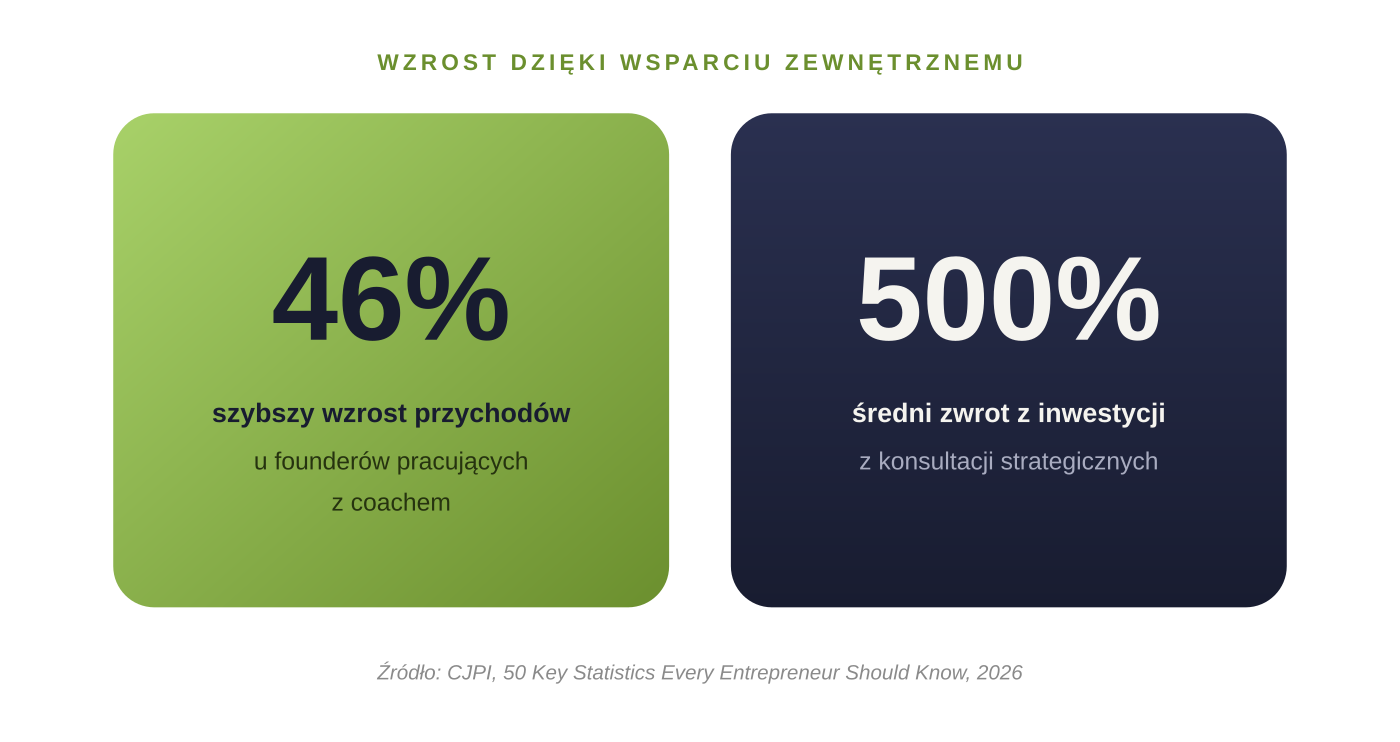
These numbers are important, but they don't answer the "why" on their own. And that's the question you really need an answer to before you decide to work with anyone.
Why knowledge alone isn't enough
Jeffrey Pfeffer and Robert Sutton, professors at Stanford University, described a phenomenon in their book "The Knowing-Doing Gap" that, in my opinion, explains most of what I see in my work with clients. They asked the question: why do so many training sessions, consultations, books, and studies produce so little real change in the actions of companies and managers [3]? Their answer is both simple and uncomfortable: the problem is almost never a lack of knowledge about what to do. The problem is the gap between knowing and doing [3].
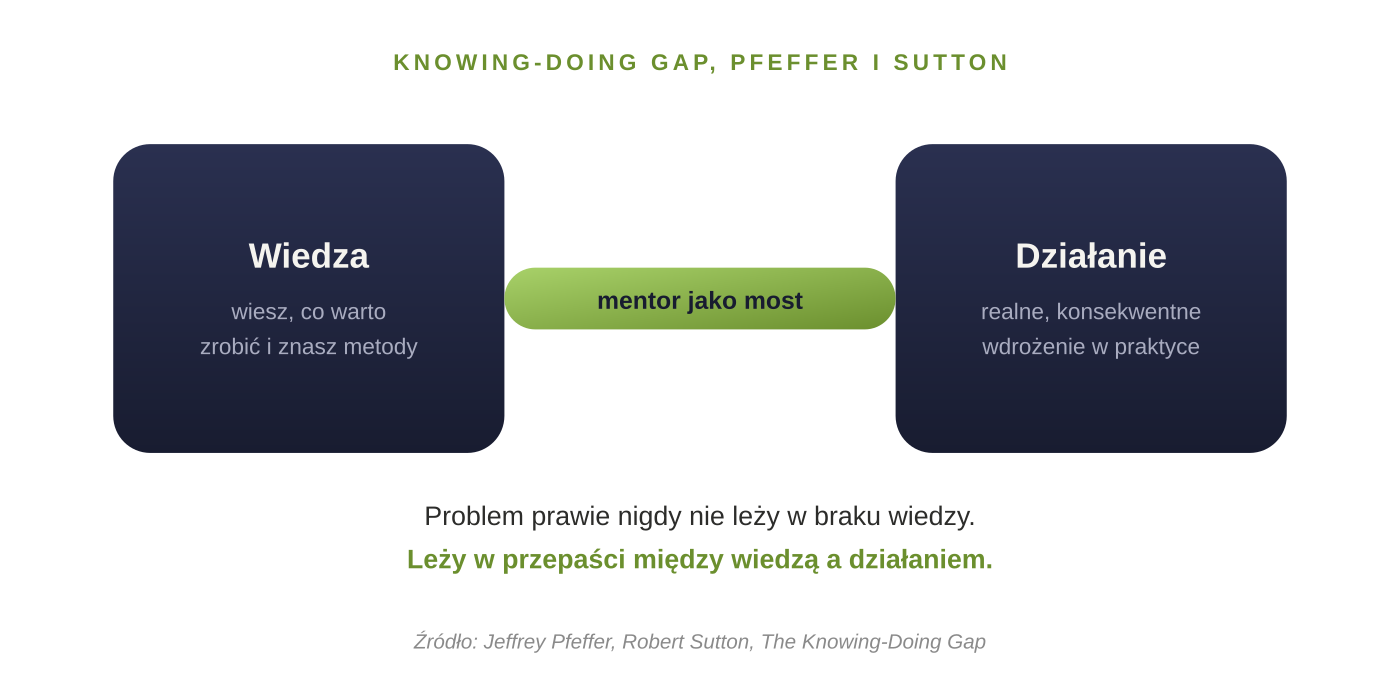
This is exactly what I hear from my clients, almost word for word. One of the people I work with told me directly: she knows it's important to act strategically and she knows the methods, but she doesn't do it on her own because she lacks motivation and direction. This isn't someone who needs another course or another book. This person already knows. She needs someone to help her regularly translate that knowledge into concrete action, week after week.
Five situations where a mentor makes a difference
Below, I describe a few real, anonymized situations from my clients so you can see what this difference looks like in practice, not just in theory.
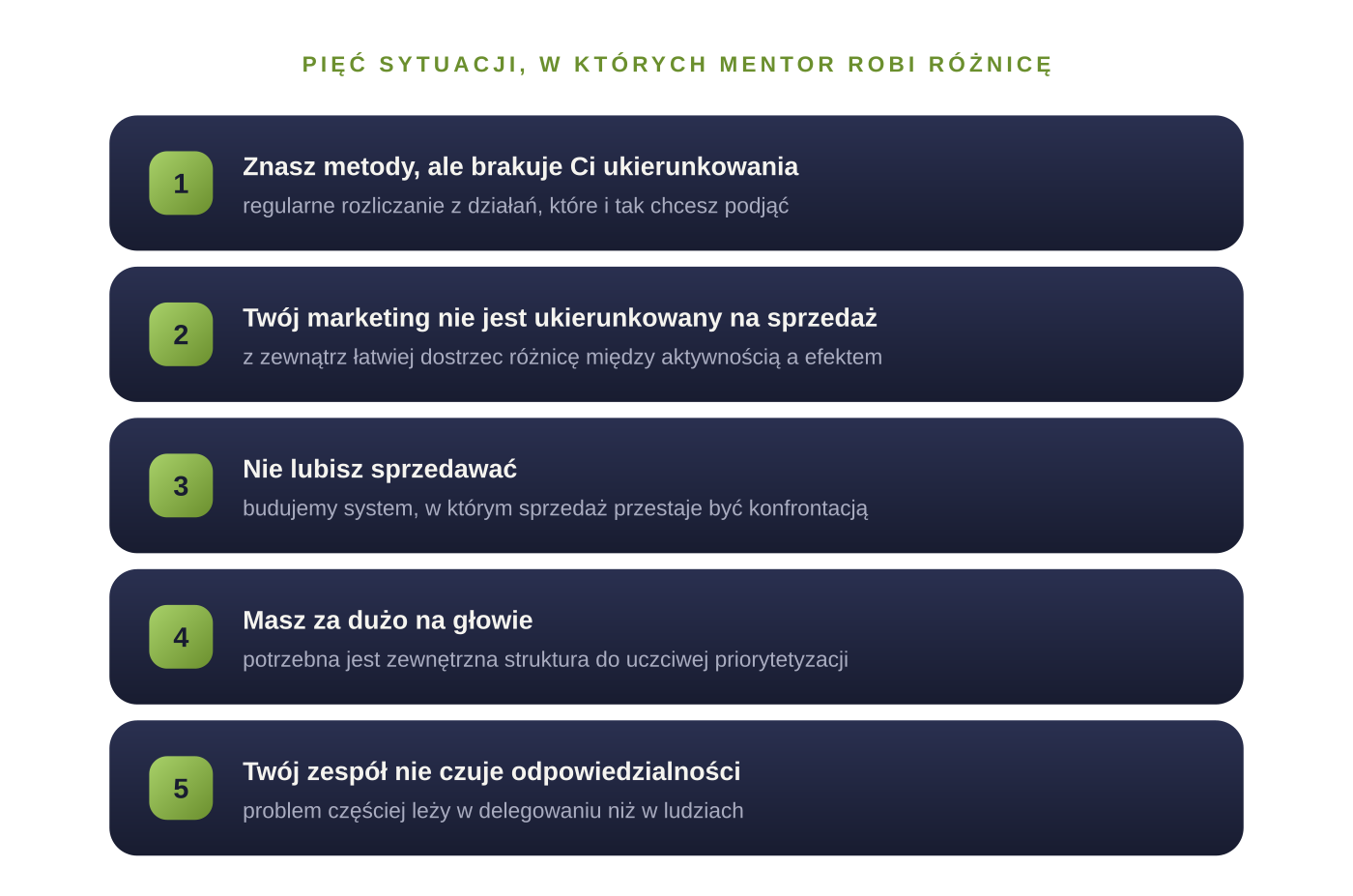
"I know it's important to act strategically and I know the methods, but I don't do it on my own; I lack motivation and direction." This is the exact "knowing-doing gap" situation I described earlier. The mentor's role here is not to teach something new, but to provide regular, cyclical direction and accountability for actions that the person wants to take anyway.
"I'm running marketing activities, but even though I have a B2B offer, they aren't focused on sales, only on brand awareness." This is a classic example of a mismatch between strategy and business goals, which is very difficult to see from the inside. When you're deeply immersed in your own marketing, it's easy to confuse activity with effectiveness. An outsider, looking at it without emotional attachment to a specific campaign, sees this inconsistency immediately.
"I don't like selling." This is one of the most common barriers I encounter with founders, especially those with an expert background rather than a sales one. Working with a mentor in this area rarely involves "learning to like sales." It's about building a system and a process where selling stops being a personal confrontation and becomes a methodical, predictable process that is easier to accept, even for someone who naturally dislikes it.
"I have too much on my plate, so I can't deal with this or that." This is a sign that an external structure for prioritization is missing. When everything seems equally urgent, you need an outsider to help you honestly answer the question of what actually moves the business forward versus what just creates a feeling of being busy.
"My team doesn't feel a sense of responsibility for what we do for clients." This is a topic I've dedicated a separate article to about delegation, and it directly relates to research on psychological ownership: people get engaged and take responsibility when they feel they have a real impact and agency over what they do [5]. Very often, it turns out the problem isn't with the people, but with the way tasks and goals are delegated to them.
What a mentor won't do for you
I want to be honest here: a mentor won't do your work for you, won't make decisions for you, and won't guarantee a specific financial outcome. The data shows a correlation between mentoring and growth, not a magical guarantee. What a good mentoring relationship really provides is a regular, external perspective, direction, and accountability for the actions you already know you should be taking. The rest is up to you.
An Invitation
If you recognize yourself in any of the five situations described above, or if you're simply asking yourself the same question I mentioned at the beginning, the best way to find out is not by reading another article, but by having a conversation.
I invite you to a free 30-minute 1:1 mentoring session (with the option to extend to an hour). No strings attached, no sales pressure. You'll see for yourself if this perspective actually changes anything.
Email me if you'd like to schedule a time.
Sources
[1] SCORE, Business Mentoring Increases Start-Up and Survival Rates
[2] CJPI, 50 Key Statistics Every Entrepreneur Should Know About Business & Growth in 2026
[3] Jeffrey Pfeffer, Robert I. Sutton, The Knowing-Doing Gap: How Smart Companies Turn Knowledge into Action, Harvard Business School Press, 2000
[4] Mentorloop, Mentoring Statistics You Need to Know, 2026
[5] ScienceDirect, Psychological ownership research in business: A bibliometric overview and future research directions